


Recently I was with a gathering of people working on a range of humanity’s most pressing challenges. Climate change, regenerative agriculture, migration policy, the erosion of democratic norms. I always feel a bit of a fraud in those settings. I am no longer working directly in policy, and though I am chair of Larger Us, most of my work involves writing, speaking, coaching and living around themes that can seem pretty nebulous. I have been following a thread of curiosity towards aspects of human cultures which have long been seen as peripheral, mainly because they are not easily measurable or perhaps more importantly, easily commodified. What is the sacred that we can gather around? What is the texture, the sensibility of our relationships? What is going on in these subtle, almost musical patterns of tone and linguistic cadence and body language, these stuttering, fractured choreographies of presence and belonging? What are the stories we are telling about what a human is, what we need, what a good life might look like now? Are they drawing us towards each other, or the opposite? How might we learn, again, to be with each other? Even, (whisper it) to love each other, as ourselves?
When did you last go to a gig (or a service) and have the instruments drop away, leaving the gathered people singing together? You might have had a taste of it recently at a carol concert or with friends around a tree. You probably didn’t though. Statistically. I think it is one of the reasons people pay silly money to go to gigs when the sound quality would be basically the same through some good headphones, at home. The thrill of live music or clubbing is mainly the vibrations going through a group of gathered bodies, the syncing of our heartbeats, collective euphoria, collective tears.
Sometimes when I am feeling insecure I‘ll try and turn these more poetic intuitions into prose, to say I work on “social cohesion” or “spirituality” or “anti-polarisation”. I’m not being fully honest when I do. I think relationships are everything. The failure of them is under all those very concrete problems my esteemed colleagues are throwing their lives at, the healing of them the source of our deepest gladness. You could say we are pack animals living as lone wolves. Or we are creatures made in the image of a relational divine, living in outright denial of that fact. However you want to frame it, individualism is anti-human. It is self-harm.
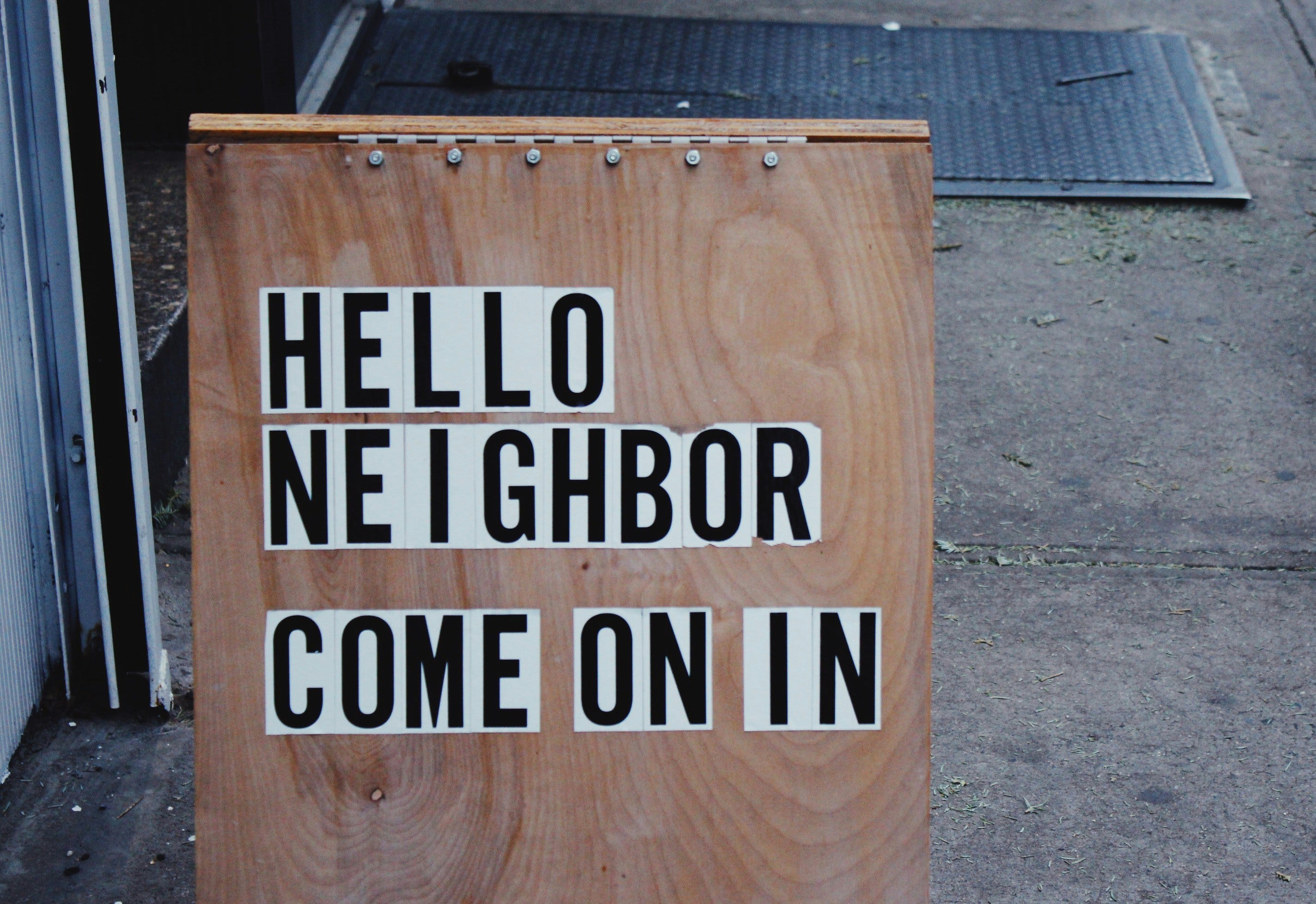
When we speak about relationships, our minds often go to the romantic ones, beyond that, possibly close friends and family. I do think these are important, but the wider web, the constellation of human connections by which we are held in healthy cultures often gets overlooked. I use “neighbouring” as shorthand for this. I do mean local neighbours, but also all the many people with whom our lives intersect. This year, I think we would all do well to be paying attention to those relationships. I think doing so seriously would make all the big, presenting problems better. For example:
Neighbouring is future proofing and resilience planning.
If you’re interested in the onrushing effects of the climate emergency, you can think of it as a purely scientific problem of parts per million of carbon, or you can notice that we no longer know how to share. What has driven out of control consumerism is a desire to avoid the entanglements of mutuality. Rooted, functioning, interdependent communities don’t need so much stuff, so much space to hide away in, so much land to act as a barrier against other people. The pub, in UK culture, was essentially the whole street’s living room. We could walk, not fly to see our friends. As the impacts of climate change hit, our greatest safety is going to be each other, the local people we live alongside and who, if like most of us you live in a city, you may never have had a conversation with. One good, manageable resolution might be just to learn all your neighbours names (unless you live somewhere rural, where you probably already do).
Neighbouring is democracy defence.
Ditto, evidence shows that democratic health relies on our ability to relate to each other. The most isolated we are, the more suspicious of other people, the less we are prepared to believe anyone can be trusted. Support for radical right wing parties is correlated with loneliness1.
Neighbouring is terrorism prevention
Isolation drives radicalisation, terrorism and violence more generally. If this sounds like an over claim, look out for an upcoming Sacred Podcast episode I recorded with Elizabeth Neumann, an eminent senior Homeland Security professional and leading expert in this area. Speaking about her book Kingdom of Rage (about the radicalisation of American Evangelicalism, a community she was and is part of), we concluded that neighbouring is terrorism prevention (this is the conversation which helped me see this pattern). Extremists, violent and otherwise, are not, (perhaps surprisingly) more likely to be mentally ill, or poor, but they are more likely to socially isolated and to feel themselves humiliated and rejected.
Neighbouring can mitigate the challenges of migration
If you’re worried about migration, either that there is too much of it or the growing hostility towards it, relationships help there too. Functioning neighborhoods make it less likely people will have to flee their homelands. When they do move country, from desire or necessity, interconnected local communities have more capacity to provide welcome without getting overwhelmed. When we know each other, even in real financial precarity, there is more resilience, we can handle change better2.
Neighbouring is a powerful public health programme.
I don’t need to tell you that loneliness has huge negative health impacts. According to one study it increases the risk of premature mortality by 26%. You are more likely to develop depression if you’re lonely. Loneliness can literally kill you, which means neighbouring might be able to save you.
Neighbouring makes us happier
The strength of our relationships with others is the number one predictor of health and happiness. A Washington Post article this week seemed shocked that bigger houses might be inversely correlated with life satisfaction, because they tend to be in less densely packed neighborhoods where people know each other less. I quote “Humans aren’t very good at prioritising what makes them happy, economists say, especially when it comes to living arrangements. We systematically overlook the costs (mortgages, commuting, maintenance) while dramatically undervaluing intangible benefits that actually dictate our happiness (seeing our kids at night, hanging with friends, knowing our neighbours and walking places)”.
How do we neighbour?
So what do I mean by neighbouring? Many of you are already doing it far better than me, especially if you’re from a generation or a location where you never lost these skills. So what I am going to say may sound absurdly simple, but for my generation, my educational history, city dwellers like me, it’s not. Here are some places to start.
Know your neighbours names. This might require some awkward doorstep conversations as you start to model different norms. Tolerate being the weirdo. Social awkwardness will not kill you. Ask them for help sometimes, offer help. Invite them to parties. Actually throw parties! When new people moved in next door we gave them a spare shed key so they can just get in and use our tools, lawn mower, chairs etc - all of which, by the way, we picked up off the street or received second hand. It isn’t a lot but it was a small signal of wanting to be more interdependent. Each street only really needs one saw, one sander, maybe a few lawnmowers if there are lawns. I like the concept of the Library of Things for reducing consumption, but I am a bit sad that it removes the need to actually see your neighbours in order to pick stuff up and drop it off.
Full disclosure, all this is hard going in our street, in our fairly transient part of London. Getting to know our neighbours has been a long, slow, sometimes discouraging job. I’m partly writing to remind myself, to invite myself to recommit to this practice.
Feed people. Almost every wisdom tradition centres gathering around a table. It is harder to hate people you have shared a meal with. It doesn’t have to be expensive (sometimes all we do is a pot of daal and rice) and your home doesn’t need to be fancy (cushions on the floor will do, in a pinch), but to welcome people across your threshold and attend to their bodily needs is a sacred act. I’ve been learning more about the radical priest Ivan Illich from my friend Dougald Hine and sitting with this quote:
I do think that if I had to choose one word to which hope can be tied it is hospitality. A practice of hospitality— recovering threshold, table, patience, listening, and from there generating seedbeds for virtue and friendship on the one hand — on the other hand radiating out for possible community, for rebirth of community.
Join something. Something that requires physical gathering. Extra points if is something that puts you alongside people outside those arbitrary age, education and social economic brackets we get so easily sorted into. If this feels too much, start wherever you can. For us it is a local church, but it might be another kind of congregation, a choir, a civic service organisation. Again, if you are 50+ you might be thinking “I am part of too many things!”, in which case ignore this. The key is not to just drop in and out as you fancy it, but to be (as far as is possible, with your particular body and nervous system and economic or caring constraints, obviously), reliable. 2026: flakiness out, commitment in.
Move into a commune. I’m only joking. Or am I? This is obviously not currently an imaginable option for a lot of people, but we have found in our intentional community/micro-monastery that having more people to share household tasks with has increased our capacity for hospitality, our access to physical space. We never would have afforded a home that can hold 12-16 people for dinner every other Monday alone. I don’t like the phrase economies of scale because it’s so machiney, but I can’t think of an organic metaphor. One of the reasons many of us don’t neighbour is it feels like too much on top of the work, care, chores and life admin. Numbed out Netflix, we tell ourselves, is all we have energy for. So there may be tweaks to the way you live which might make neighbouring seem more possible. As I wrote in the New York Times this week, even if that isn’t for you, the relational principles still hold.
As we go into a year which seems likely to become more, not less turbulent, reminding myself that relational practices underpin everything has helped restore my sense of agengy. I can’t do anything about Venezuela, or AI, or many other things. Some of us are called to try and turn the ship at global level, to tackle the symptoms using tools of policy and practice. If that is you, I’m cheering for you. I’d love to send you a care package, settle you down for a nap on our battered, stained, second hand sofa. I hope someone is neighbouring you. We don’t all have access to those levers. We all, however, have contact with people. We can all find ways to resist the isolating, dehumanising tides of our time attempting to turn us into machines. We can all figure out a few small ways to be together more, in our bodies, to call a friend to ask for help, to offer a place to sleep or a cup of tea. These things seem soft, naive even but they are perhaps the most radical, powerful acts in these times. Kettle’s on, how do you take it?
“Loneliness is positively associated with support for the populist radical right in the Netherlands. The effect sizes are comparable to common health correlates of loneliness - high blood pressure, heart diseases, and depression – emphasizing their socio-political relevance.” https://www.sciencedirect.com/science/article/pii/S027795362500005X#bib7
This is the weakest point in my list, I realise, because there are quite a few nuances here I will need to flesh out in a later post. I do agree that neighbouring is easier if you begin with things in common, but that doesn’t mean it isn’t possible in areas of high diversity like ours. There is a lot more I could say about the postures, narratives and infrastructure implications of this point, so for now if you don’t agree with me that is fine.
Hello Elizabeth. Jason here, at Front Porch Forum. Thank you for this. I'm sharing it with our team as we map out our plans for the year. At FPF, every year has been the year of neighbouring (I like the British spelling better!), but this year even more so.
Please know that what you write plays a very deep and meaningful role in shaping how we support and encourage our 250,000 Vermont members to connect with their neighbours and build community. Thank you.
"Kettle’s on, how do you take it?"
(YES!)